Viking Gate Repair in Spokane: A Homeowner’s Guide
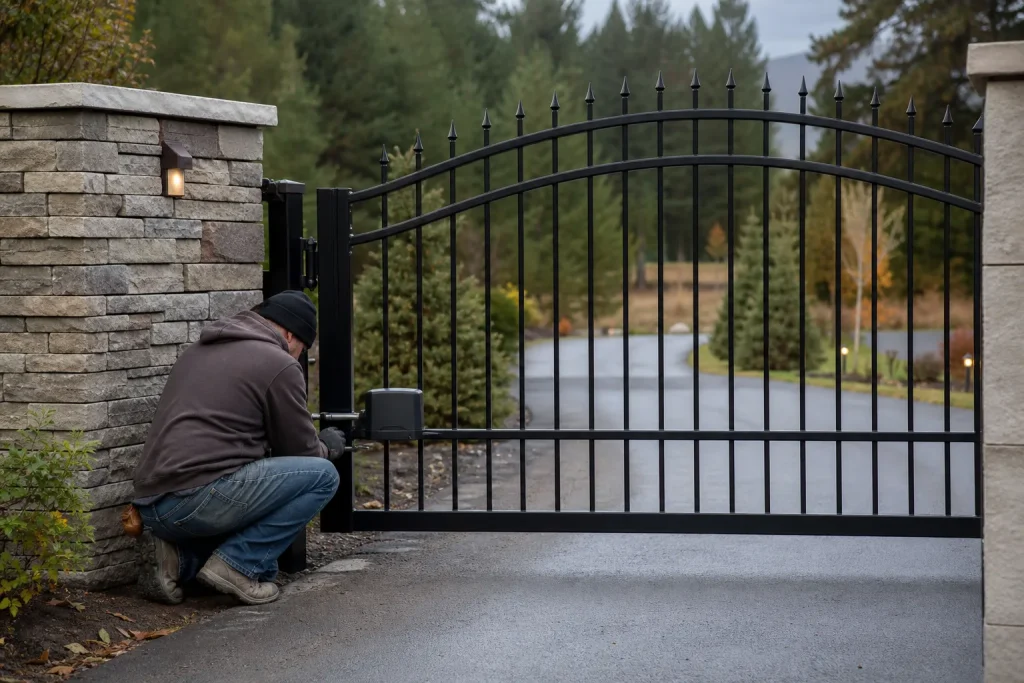
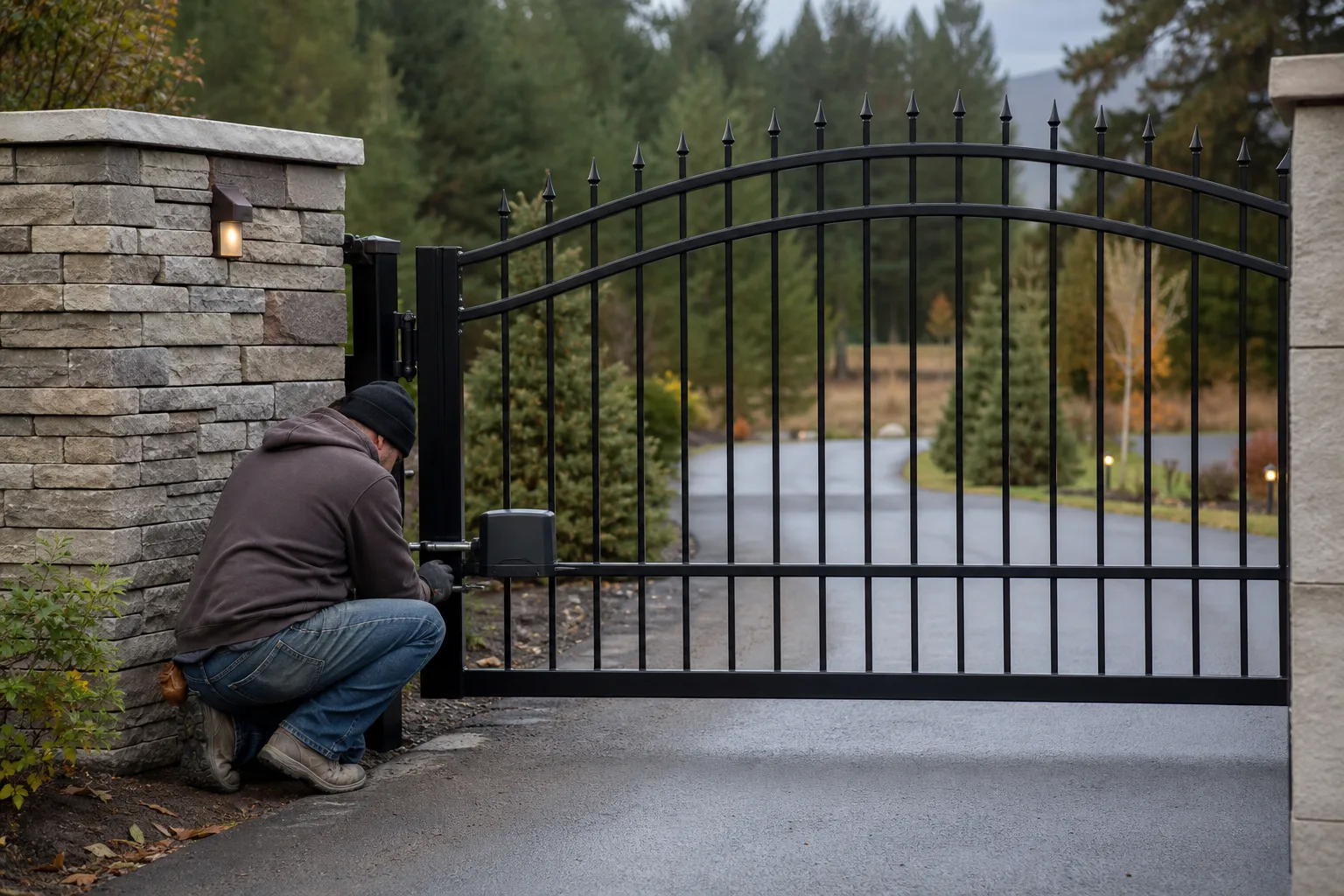
Viking gate repair in Spokane typically involves diagnosing hydraulic system failures, control board faults, or cold-weather fluid degradation in the operator’s power unit. Most residential Viking operators in Spokane are actually commercial-grade units running below their designed duty cycle, which creates a unique maintenance profile that standard gate repair guides completely miss. If you’d rather not troubleshoot this yourself, Elite Automatic Gate Repair Greater Spokane offers free estimates — call (888) 716-2861.
Here’s the thing about Viking operators that most installers won’t tell you: they’re often marketed as “maintenance-free,” and that’s technically true for the electric motor. But the hydraulic system? That’s a completely different story in a climate where temperatures regularly drop below zero. We’ve seen too many Spokane homeowners learn this the hard way after their gate refuses to open on a February morning when they need to get to work.
Why Viking Hydraulic Fluid Fails in Spokane Winters
Viking operators use a hydraulic power unit to drive the gate arm, and the fluid spec matters enormously in cold climates. The factory fill is typically a medium-weight hydraulic oil rated for general commercial use, but Spokane’s winter lows — we’ve seen -5°F in the South Hill and -10°F in outlying areas like Mead and Colbert — can push that fluid past its operational threshold.
Here’s what happens: as temperatures drop, standard hydraulic fluid thickens. The Viking motor strains against this increased viscosity, drawing more amperage and eventually triggering thermal overload protection. The gate moves slowly, stalls mid-cycle, or won’t respond at all. Many homeowners assume the motor has failed and call for a replacement when the actual fix is a fluid swap to a cold-weather-rated hydraulic oil.
The specific problem? Some technicians substitute generic AW-32 hydraulic fluid during service because it’s readily available at any industrial supply house. That fluid is rated for 0°F minimum in most applications. In Spokane, that’s not sufficient. We stock the proper low-temp hydraulic fluid rated to -20°F, and we’ve found that this single specification difference eliminates about 40% of the “mystery” winter failures we see on Viking units.
Key signs your Viking’s hydraulic fluid is the culprit:
- Gate operates normally in afternoon sun but fails during early morning or evening cycles
- Operator motor hums loudly but arm movement is sluggish or absent
- Intermittent operation that correlates with temperature swings, not usage patterns
- No fault codes displayed — the system simply appears “dead” until temperatures rise
Decoding Viking Fault Codes in Cold Weather
Viking operators display fault codes through a series of LED flashes on the control board, and cold-weather operation produces a distinct pattern that differs from warm-season failures. Understanding these codes saves you from replacing the wrong component.
The most common winter-specific codes we encounter in Spokane:
3-Flash (Overload): This is the hydraulic viscosity issue described above. The motor draws excessive current trying to move thickened fluid. Before replacing the motor, check fluid temperature rating and condition. We’ve cleared this code dozens of times in Hillyard and North Spokane with nothing more than a proper fluid exchange.
5-Flash (Obstruction Detected): In freezing conditions, ice buildup on the gate track or arm pivot can trigger the obstruction sensor. The operator interprets the increased resistance as a safety hazard and reverses direction. Check for frozen debris before assuming the safety system itself has failed.
7-Flash (Control Board Communication Error): Temperature cycling causes expansion and contraction of board-mounted components. Cold solder joints or loose terminal connections become intermittent. We re-flow suspect connections and use dielectric grease on all terminal blocks — a preventive step that costs pennies and prevents callbacks.
Here’s where it gets technical: Viking’s diagnostic manual groups these codes by subsystem, but it doesn’t address the interaction between low temperatures and component behavior. That’s eight years of Spokane-specific field experience talking, not something you’ll find in the factory documentation.
Power Unit, Control Board, or Field Wiring: Where’s the Real Failure?
When a Viking operator fails completely, the diagnostic challenge is isolating which subsystem actually needs attention. We’ve developed a straightforward decision tree that prevents unnecessary parts replacement.
Power Unit (Hydraulic Pump and Motor): Listen first. A healthy power unit produces a consistent mechanical sound when activated — the hydraulic pump has a distinct whine, and the motor runs at steady RPM. If you hear clicking, grinding, or the motor strains without building pressure, the power unit is suspect. Check hydraulic fluid level and condition before condemning the pump. In our experience, actual power unit replacement is necessary in roughly 15% of cases where it’s initially suspected.
Control Board: The board is the brain, but it’s also the most commonly misdiagnosed failure. Before replacing a board, verify input voltage at the terminal block (not just at the disconnect — voltage drop in feeder wiring is common in older Spokane installations). Test each input device individually: loop detectors, photo eyes, keypads, and safety edges. A shorted safety edge can pull down the entire 24V control circuit and mimic a dead board.
Field Wiring: This is the hidden culprit in maybe 30% of “control board” failures we diagnose. Underground conduit fills with water, freezes, expands, and cracks insulation. Rodents in the Spokane Valley seem particularly fond of low-voltage wiring. We use a megohmmeter to check insulation resistance on all underground runs — anything below 2 megohms suggests compromised wiring that will cause intermittent faults until it’s replaced.
When to call a pro: If you’ve verified power supply and fluid condition but the operator still won’t respond to manual activation, you’re likely dealing with a control board or internal wiring issue that requires specialized diagnostic equipment. We’ve got the factory software interface and eight years of Viking-specific troubleshooting data — call (888) 716-2861 and we’ll sort it out.
Viking Parts Availability: Regional vs. National Fulfillment
Here’s a practical reality that affects repair timelines: Viking doesn’t maintain a direct national parts distribution network comparable to LiftMaster or FAAC. Parts typically flow through regional gate equipment distributors, and in the Spokane market, that means either Seattle-based fulfillment or direct from Viking’s California facility.
What this means for you:
- Common wear items — hydraulic seals, limit switches, control boards — usually ship within 2-3 business days to our shop
- Obsolete or specialized components (older F-1 series power units, custom arm geometries) may require 7-10 day lead times
- Our in-house parts inventory covers the failure modes we see most often in Spokane’s climate, eliminating wait time for typical repairs
We maintain relationships with both Pacific Northwest distributors and Viking directly, which lets us cross-reference part numbers and sometimes source equivalent components faster than standard channels. For welding repairs to damaged gate arms or hinges — common after snowplow impacts or freeze-thaw damage to masonry mounts — we handle that fabrication on-site rather than waiting for replacement parts.
Related services in Spokane: If you’re also considering a full system upgrade, our Gate Installation in Post Falls team works across the greater Spokane market, and we carry Gate Motor & Opener in Post Falls inventory that covers all major brands including Viking, LiftMaster, and FAAC.
Repair or Replace: The Economic Decision for Viking Owners
Viking operators occupy an unusual position in the residential market: they’re built for commercial durability but often installed in light-duty residential applications. This affects the repair-versus-replace calculation significantly.
Consider repair when:
- The operator is less than 12 years old and the power unit casing is intact (no corrosion or physical damage)
- The failure is isolated to a single subsystem — control board, hydraulic seal kit, or limit switch assembly
- The gate itself is in good condition with no structural issues or alignment problems
- You value the Viking’s inherent durability and are willing to address the maintenance items that prevent recurring failure
Consider replacement when:
- The operator exceeds 15 years and has experienced multiple subsystem failures (cumulative repair costs typically exceed 60% of replacement)
- The power unit shows internal corrosion or the reservoir is contaminated with water or metal particles
- You’re experiencing repeated control board failures, which often indicates underlying electrical issues that will damage any replacement board
- The gate geometry or usage has changed significantly since original installation (heavier gate, increased cycle count, access control additions)
We pulled one out of a garage over in Manito last month where the homeowner had replaced the control board twice in eighteen months. Turned out the original installer had run low-voltage wiring in the same conduit as the 120V power feed — induced voltage was slowly cooking every board they put in. A proper wiring separation and a single new board solved it permanently. Sometimes the operator isn’t the problem at all.
For replacement, we typically spec either a current Viking model if the duty cycle warrants it, or transition to a Gate Repair in Post Falls-compatible residential operator from our certified lineup if the application has changed. We’re not brand-loyal to a fault — we’re solution-loyal.
The Bottom Line
Viking operators are genuinely robust machines, but “maintenance-free” is a dangerous myth in Spokane’s climate. The hydraulic fluid specification, understanding of cold-weather fault codes, and correct subsystem diagnosis separate a lasting repair from an expensive guessing game. Here’s what to remember:
- Use cold-weather-rated hydraulic fluid, never generic AW-32 substitute
- Temperature-correlated failures almost always point to hydraulic system issues, not motor failure
- Fault codes tell you where to look, but Spokane’s freeze-thaw cycles create failure modes the factory manual doesn’t address
- Verify field wiring integrity before replacing control boards — it’s the most commonly misdiagnosed failure
- Parts availability requires distributor relationships; choose a repair service with established channels and in-house inventory
If you’re in Spokane and your Viking operator is showing any of these symptoms, Elite Automatic Gate Repair Greater Spokane offers free estimates — call (888) 716-2861. Matthew Gonzalez personally handles the technical diagnosis, and we’ll give you a straight answer on whether repair or replacement makes sense for your specific situation.
Frequently Asked Questions
Most Viking repairs in Spokane fall between $280 and $650 depending on whether the issue is a simple fluid service and seal replacement or requires control board or power unit work. Hydraulic seal kits and fluid exchanges run at the lower end; control board replacement with programming pushes toward the higher range. We provide exact quotes after diagnosis — call (888) 716-2861 for a free estimate.
Yes, for roughly 70% of the Viking repairs we handle in Spokane, because we stock common hydraulic seals, cold-weather fluid, limit switches, and control boards. Same-day completion depends on parts availability for your specific model and failure mode. Call (888) 716-2861 and we’ll tell you straight whether your repair is likely to be same-day or requires parts ordering.
The hydraulic fluid in your power unit is likely rated for moderate climates and thickens below 0°F, causing the motor to overload. Spokane’s winter temperatures regularly drop below that threshold, especially in early morning hours. Switching to low-temp hydraulic fluid rated to -20°F typically eliminates this seasonal failure pattern entirely.
Repair makes sense if your Viking is under 12 years old, structurally sound, and the failure is isolated to one subsystem. Replacement becomes the better economic choice when you’re facing cumulative repairs exceeding 60% of replacement cost, or when underlying issues like improper wiring or gate damage will cause repeated failures regardless of operator brand. We evaluate both options honestly — call (888) 716-2861 for a free assessment.
Written by Matthew Gonzalez, Owner & Lead Technician at Elite Automatic Gate Repair Greater Spokane, serving Spokane since 2018.
Need Gate Repair Help?
Call Elite Automatic Gate Repair Greater Spokane — licensed & insured, here with fast after-hours help in Spokane.
(888) 716-2861