How to Choose the Right Gate Repair Company in Spokane
Choosing the right gate repair company in Spokane means finding a single-trade specialist who stocks parts, performs diagnostics before quoting, and stands behind the work with owner-level accountability. Look for deep brand knowledge across systems like LiftMaster and FAAC, verified review volume above 500, and in-house welding capability that eliminates subcontractor delays. If you’d rather skip the evaluation and talk directly to a technician, call us at (888) 716-2861 — estimates are free.
Nearly 40% of gate repair callbacks in the trades trace back to the first technician misdiagnosing the root cause. That failure mode is structurally more common in general handyman operations than in single-trade specialist shops. We’ve spent eight years in Spokane cleaning up after those callbacks — bent gate arms that were “fixed” with bigger motors, control boards replaced when the real problem was a pinched low-voltage line running through a frost-heaved post in the South Hill. The gate industry doesn’t regulate entry tightly, so the burden of vetting falls on you. Here’s how to do it right.
Why Review Volume and Recency Both Matter — and What Their Ratio Reveals
Homeowners in Spokane often check star ratings first and stop there. That’s a mistake. A 4.9-star average built on 47 reviews tells a completely different story than the same score across 755 verified jobs.
Here’s what to look for:
- Total volume above 500 — At this scale, a company has crossed from “occasional gate job” to “repeatable process.” Statistical noise fades out. Patterns become visible.
- Reviews within the last 90 days — Gate repair is seasonal in Spokane. Freeze-thaw cycles, wind loads on the Palouse, and snow drift against sliding gates create distinct winter failure modes. A company with steady recent reviews is actively solving current problems, not coasting on reputation.
- The volume-to-recency ratio — Divide total reviews by months in business. A company with 200 reviews over eight years averages two per month. That’s thin. Our 755 reviews across eight years works out to nearly eight per month — a pace that indicates consistent demand and consistent delivery.
Read past the “great guys, showed up on time” surface. Look for gate-specific competence: mentions of motor brands, access control troubleshooting, or welding repair. General friendliness doesn’t fix a FAAC 390 barrier arm that’s throwing intermittent fault codes.
The Single Question That Separates Parts-Stocking Specialists from Parts-Ordering Generalists
Ask this exact question: “What motor and control components do you carry on your service vehicle right now?”
The answer reveals everything. A generalist who added gates to a garage door or fencing operation will describe a parts-ordering workflow: diagnose, quote, order, return in 3–5 business days. In Spokane, that timeline stretches easily to two weeks when winter weather hits I-90 shipping routes.
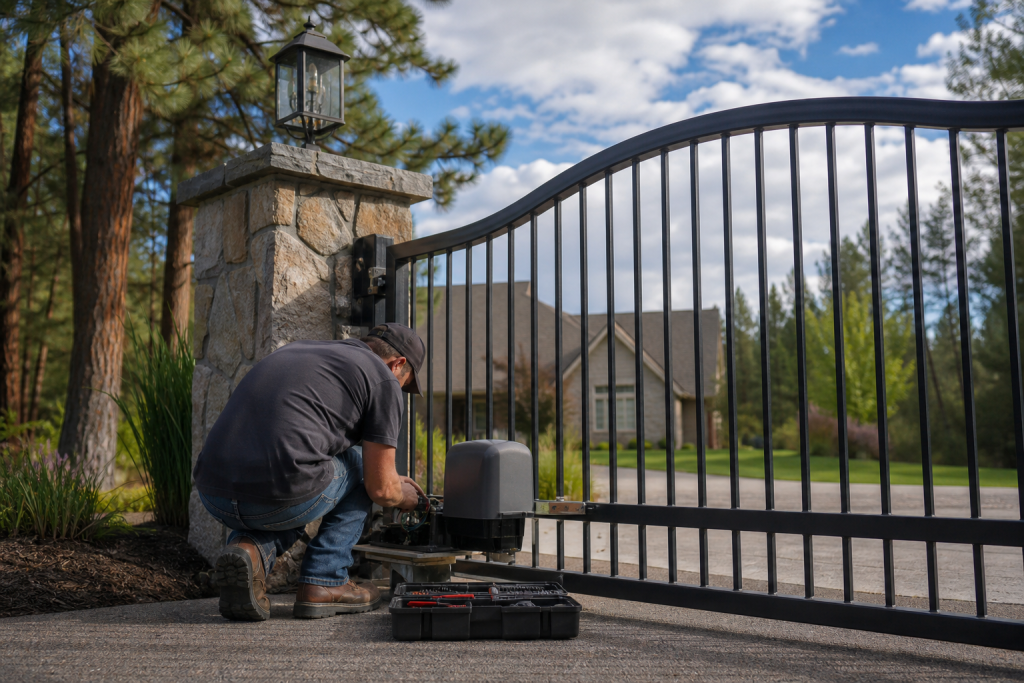
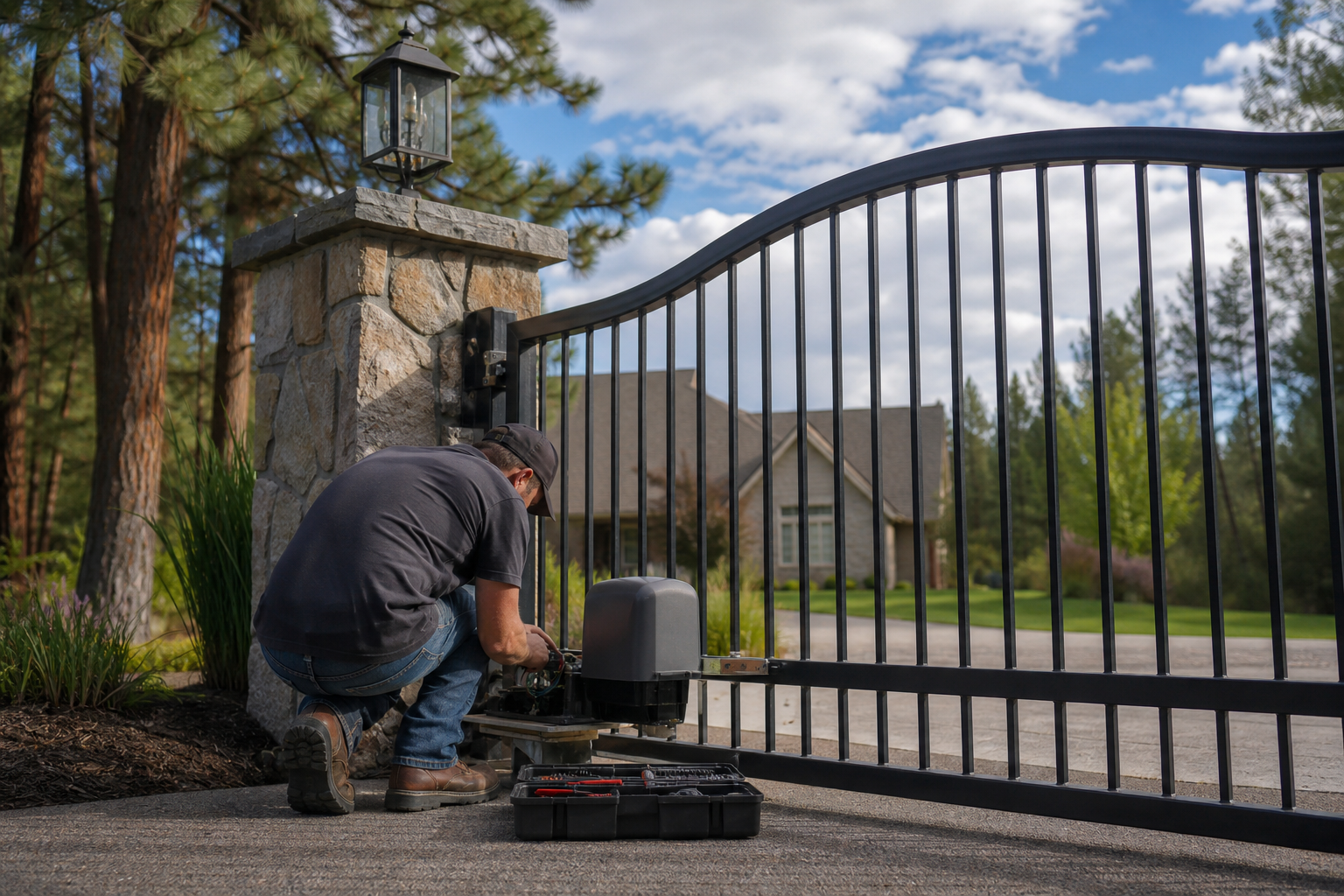
A single-trade specialist stocks capacitors, limit switches, gear assemblies, and replacement boards for the brands they service. We carry components for LiftMaster, FAAC, BFT, and others on every truck, plus a portable welding rig. When a gate arm shears at a commercial property in Spokane Valley, we don’t call a subcontractor — we cut, fit, and weld on-site.
The follow-up question seals it: “What happens when you don’t have the part?” A specialist has sourcing relationships and can explain exactly how they handle the exception. A generalist will describe “checking with their supplier,” which means you’re paying for their learning curve.
How to Evaluate Contractor Accountability: Owner-Operated vs. Franchise vs. Subcontractor
Accountability in gate repair shows up when something goes wrong — not when everything goes right. Here’s how the three models actually function:
- Franchise operations — Technicians are employees following brand protocols. Quality varies by location and turnover. The owner you spoke with on the phone is rarely the person at your gate.
- Subcontractor networks — Your job gets dispatched to an independent operator you’ve never vetted. Warranty claims bounce between the platform and the subcontractor. We’ve taken calls from Spokane homeowners who couldn’t reach their original “company” six months after install.
- Owner-operated specialist — Matthew Gonzalez functions as Lead Technician. The person who answers technical questions, diagnoses failures, and stands behind the repair is the same person who did the work. When a property manager on the North Side calls about a gate that’s drifting open in high wind, they’re talking to the person who’ll be adjusting the magnetic locks.
Verify this practically: ask who performs the diagnostic and whether they’ll be available for follow-up. If the answer involves “dispatching someone” or “the office will coordinate,” you’re not talking to an owner-operated model.
What a Legitimate Diagnostic Process Looks Like Versus Quote-First-Diagnose-Later
The quote-first approach is common and dangerous. A technician walks up, observes the gate won’t open, and quotes a motor replacement without testing voltage at the control board, checking photocell alignment, or cycling the system in manual mode. Homeowners in Spokane pay for motors they didn’t need — we’ve removed perfectly functional LiftMaster operators where the real problem was a $12 limit switch or a spider web across the safety eye.
A legitimate diagnostic follows sequence:
- 1
Visual and mechanical inspection — Gate balance, track alignment, hinge wear, physical obstructions. In Spokane’s freeze-thaw climate, we regularly see concrete gate posts shift at the base, binding swing gates.
- 2
Electrical testing — Voltage at the operator, amperage draw during cycle, continuity in safety loops and edges.
- 3
Control logic verification — Error code retrieval, input testing from remotes, keypads, and vehicle loops.
- 4
Root cause identification — The technician explains why the failure occurred, not just what failed.
- 5
Options presentation — Repair versus replacement, with trade-offs and pricing for each path.
We spent three hours last month on a Mighty Mule system in the Garland District where two previous companies had quoted full replacement. The actual issue: a corroded ground connection at the transformer, accelerated by Spokane’s winter road salt spray. Twenty-dollar fix. Customer’s gate had been manually operated for six weeks.
How to Read Reviews for Gate-Specific Competence, Not General Friendliness
Five-star reviews that mention “polite” and “cleaned up” are table stakes. They don’t distinguish a gate specialist from a landscaper who happened to fix a gate once. Here’s what to scan for:
- Brand names mentioned — “Reprogrammed our DoorKing keypad” or “replaced the FAAC gear motor” indicates actual technical work.
- Failure mode described — “Gate was reversing for no reason” or “intermittent opening at 2 AM” shows the reviewer understood their problem and the company explained the fix.
- Structural or welding references — “Welded a cracked frame” or “reinforced the gate post” signals in-house capability that generalists outsource.
- Follow-up mention — “Called back to check” or “came out when it acted up again” indicates accountability, not transaction.
Our 755 reviews include specific mentions of all nine brands we service — Elite, Mighty Mule, LiftMaster, FAAC, BFT, Linear, Viking, Ghost Controls, and DoorKing. That breadth matters in Spokane, where a single HOA or commercial property often runs mixed-vintage equipment installed by different contractors over decades.
When to Call a Pro
Some gate symptoms are clearly beyond homeowner scope. If your gate is making grinding noises from the operator, has visible weld cracks in the frame, or is behaving erratically with no clear pattern, the underlying issue likely requires electrical testing and mechanical inspection that demands specialized tools. In Spokane’s climate, we also see accelerated corrosion in underground loops and control enclosures — problems that look like “electrical gremlins” but trace to moisture intrusion. If you’ve already tried replacing batteries or clearing obstructions and the problem persists, continuing to cycle the system can compound damage to the motor or control board.
Related services in Spokane: If you’re evaluating gate options beyond repair, we also handle new gate installation and motor and opener work throughout the region.
The Bottom Line
Choosing right the first time in Spokane comes down to four filters: review volume that proves repeatability, parts stocking that eliminates delay, owner-level accountability that survives problems, and diagnostic rigor that prevents unnecessary replacement. Miss any one, and you’re gambling with downtime, double-paying, or both.
We’ve built Elite Automatic Gate Repair Greater Spokane around eliminating those failures. Eight years, nearly 800 verified reviews, and every major brand on the market — with Matthew Gonzalez on-site for the work, not managing it from an office. If you’re evaluating options and want a direct conversation about your gate, call (888) 716-2861. Estimates are free, and we’ll tell you honestly whether your situation needs us or just a simple adjustment you can handle yourself.
Frequently Asked Questions
Most residential gate repairs in Spokane fall between $150 and $600 depending on whether the issue is electrical, mechanical, or structural. Simple adjustments and sensor realignments run lower; motor replacement or on-site welding repair runs higher. Commercial systems with multi-gate access control or barrier arms typically start higher due to component costs and code requirements. Call (888) 716-2861 for an exact quote — estimates are free.
Repair is usually cheaper if the gate frame is structurally sound and the operator is less than 10–12 years old. Replacement becomes the better value when you’re facing multiple concurrent failures — a worn motor, corroded control board, and bent track — or when parts are obsolete. We evaluate this honestly on every diagnostic in Spokane; we’ve talked homeowners out of replacement when a $200 repair would last years. Call (888) 716-2861 and we’ll assess your specific system.
Specialist shops with local parts inventory can often diagnose same-day or next-day in the Spokane area. Companies that order parts after diagnosis typically schedule 3–7 days out, longer in winter when shipping delays hit. We stock components and weld on-site, which lets us complete most repairs in a single visit. For timeline specifics on your gate, call (888) 716-2861.
Ask four questions: What brands do you service regularly? What parts do you carry on your vehicle? Who performs the diagnostic — an owner or a subcontractor? What’s your process if the first repair doesn’t resolve the issue? The answers separate parts-stocking specialists from generalists, and owner-accountable operations from dispatch networks. If you want to talk through these directly with a technician, call (888) 716-2861.
Written by Matthew Gonzalez, Owner & Lead Technician at Elite Automatic Gate Repair Greater Spokane, serving Spokane since 2018.
Need Gate Repair Help?
Call Elite Automatic Gate Repair Greater Spokane — licensed & insured, here with fast after-hours help in Spokane.
(888) 716-2861